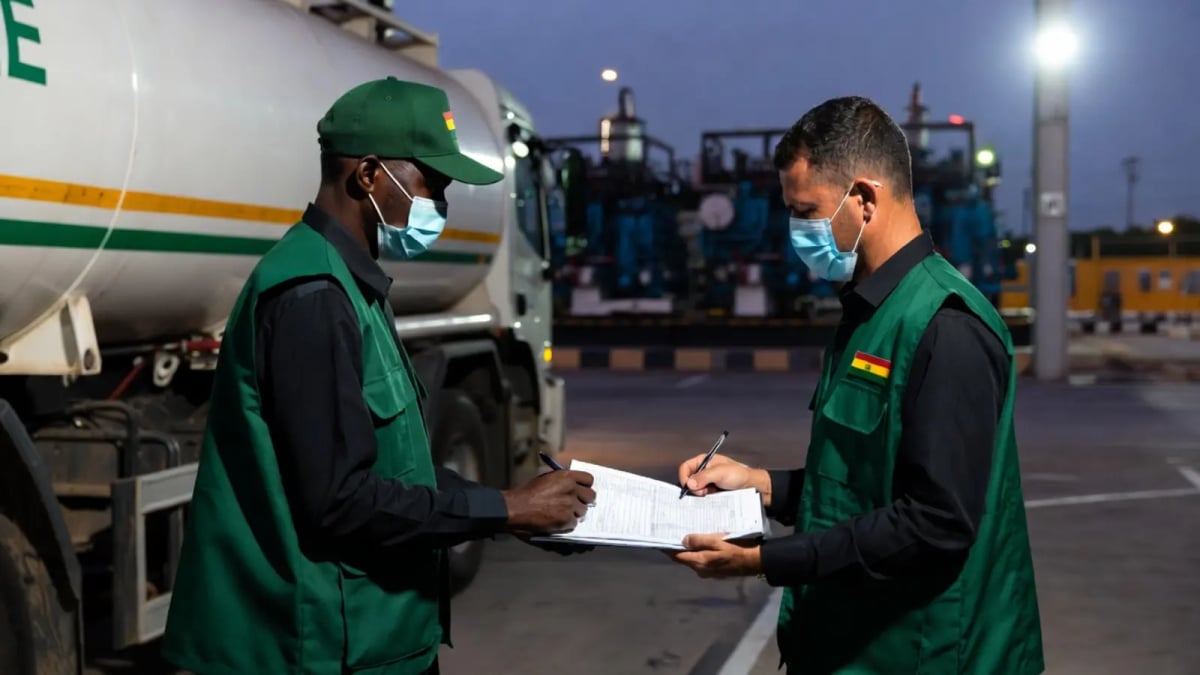
Standby fuel supply for a power operation
A power operation required reliable standby fuel to maintain continuity. The Project Office structured a scheduled supply programme with documented delivery verification.
Project Profile
Sector: Independent power generation — standby and continuous supply operations Scope: Structured standby fuel supply programme covering bulk delivery scheduling, on-site inventory management, and HSE-documented transfer protocols Geography: Southern Ghana operational corridor Duration: Ongoing institutional supply arrangement
A power operation serving critical load clients across southern Ghana required a disciplined standby fuel supply programme — one capable of sustaining generation continuity through grid disruptions, seasonal demand peaks, and extended maintenance windows. The operation ran multiple generating sets across distributed sites, each with defined minimum fuel-on-hand thresholds and zero tolerance for supply interruption.
The Supply Challenge
Power operations place petroleum supply under a different kind of pressure than standard commercial procurement. The fuel does not sit in reserve — it is consumed continuously, with generation output directly tied to inventory levels. Any gap in supply translates immediately into lost load capacity, contractual exposure, and operational risk for downstream clients who depend on uninterrupted power.
The specific challenge here was layered. Sites operated on differing tank capacities and consumption cycles. Delivery windows were constrained by site-access logistics and generating set operational schedules. Documentation requirements were stringent — every transfer required quantity verification, product quality confirmation, and HSE sign-off before any fuel entered the generation system. And the operation demanded the ability to surge delivery volume rapidly when grid conditions deteriorated and standby generation moved to continuous runtime.
Approach
Apex Africa Petroleum structured a standby supply framework around the operation’s actual consumption profile rather than a standard commercial delivery schedule. Site-by-site tank thresholds were established as trigger points for automated replenishment sequencing, removing reactive procurement from the process entirely.
Bulk delivery schedules were coordinated against the operation’s generation planning calendar, ensuring that anticipated high-load periods were preceded by verified full-tank positions at each site. Every transfer was executed under documented HSE protocol — product integrity checks, quantity reconciliation, and signed transfer records at each delivery — providing the operation with an auditable supply chain from loading point to tank inlet.
The surge-capacity requirement was addressed through pre-positioned delivery scheduling and maintained logistics readiness within the southern Ghana corridor, allowing volume uplift to be activated within the operation’s response window when extended generation runs were required.
Outcome
The power operation maintained continuous generation availability across its distributed sites without a supply-driven outage during the programme period. Inventory positions remained above minimum thresholds at all monitored sites. HSE documentation was complete and current at every delivery point, satisfying internal compliance audits and client-facing reporting obligations. The operation’s procurement team moved from reactive fuel management to a structured, calendar-anchored supply rhythm — reducing administrative load and eliminating last-minute logistics pressure.
What This Project Demonstrates
Power generation is one of the most discipline-intensive environments in which institutional petroleum supply operates. Fuel is not a commodity to be ordered when low — it is an operational input that must be managed against generation planning, consumption modelling, and HSE accountability in parallel.
This project reflects a supply pattern common across Ghana’s independent power sector: operations that carry significant load responsibility but cannot absorb the procurement management burden that disciplined fuel supply demands. Apex Africa Petroleum’s role is to hold that burden institutionally — maintaining the documentation rigour, delivery consistency, and surge capability that generation continuity requires, so that the operation’s focus remains on power output, not petroleum logistics.